Report 2026-09-08 14:12 · round 2 · 14 runs
vyomkesh · web · September 23, 2026
autoresearch · phase parked · written 2026-09-08T14:12:13.777Z
The question
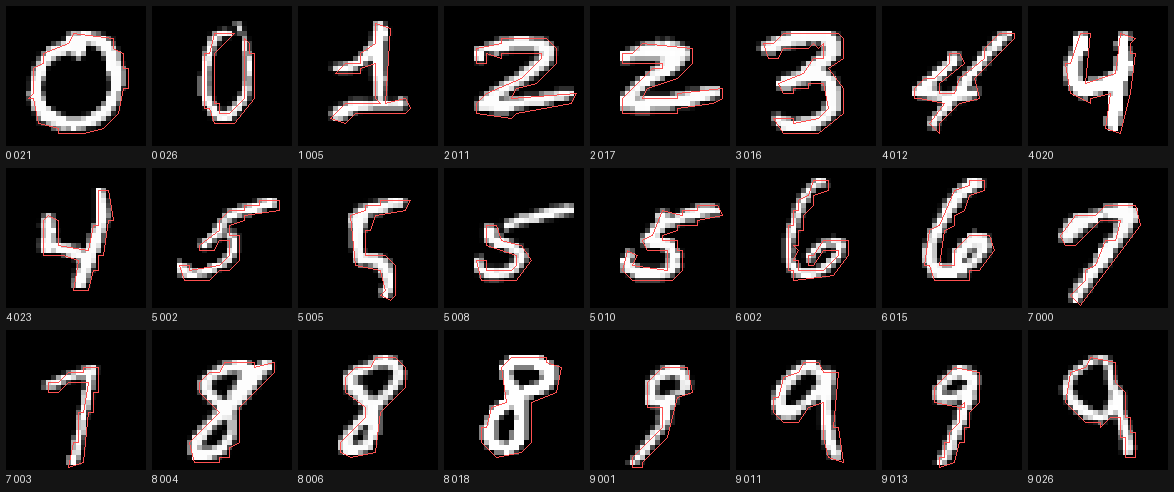
Classify handwritten digits. Given a 28x28 grayscale image of one handwritten digit, predict which of the ten digits 0-9 it is. The question is which model and training setup reads these digits most accurately, and how confident we can be in a difference given only 24 held-out images. OBJECTIVE (proposed by the Phase-0 characterisation, finding find-char-ds_fb7985d4ebd7f9f9): maximise image_class_accuracy on the sealed scored set sc_mnist_digits_b2f34dc3 — the fraction of the 24 images whose predicted dominant foreground class is the labelled digit. That is top-1 accuracy, in the user's own words. It did not exist when the brief was written; I built it into unet_small@1.10.0 and segformer_tiny@1.10.0 rather than optimise IoU because IoU was there. The truth through the recipes' own decoder scores it 1.0000 on all 24, so the instrument is valid. IoU is a SECONDARY with no guardrail. The polygon is a carrier for the class, and the tracing itself is a loose, inconsistent silhouette (interior holes filled on some digits, open on others), so a guardrail on overlap would reject a model for failing at something the user did not ask for. It is kept because it separates 'named the digit without finding it' from 'found it and named it'. minPracticalEffect = 0.0833 is TWO of the 24 images, and it is the instrument's resolution floor, not a scientifically meaningful threshold. Honest limits, measured, not assumed: chance 0.100; the majority-class constant predictor 0.167; 1-nearest-neighbour on RAW PIXELS fit on the 276 non-scored images 0.875 (21/24); perfect 1.000. The entire interesting range is three images wide, and a paired sign test over 24 items needs roughly five discordant images before a difference is more than noise. This study can establish that a model reads these digits; it cannot honestly rank two competent architectures against each other. Enlarging the scored set is the one act that changes it, and it is on the asks.
Objective: image_class_accuracy (maximize), smallest effect worth acting on 0.083.
The answer so far
THE QUESTION. Given a 28x28 grey image of one handwritten digit, name which of 0-9 it is; find which model and training setup reads these digits most accurately, and say how confident we can be given 24 held-out images.
THE ANSWER, NOW CROSS-VALIDATED BY A SECOND FAMILY. unet_small@1.10.0 at epochs=400 (12000 steps, ~147 GPU-s), image_size 64, ce_dice, augment=flip, class_weighting=none, selecting the checkpoint on val_image_class_accuracy: image_class_accuracy 0.9167 = 22 of 24, at seeds 1, 2 and 3 IDENTICALLY, per-item vectors byte-identical, seed sigma 0.000 (x1-f37d7c84a6ef, x1-ca6f1f37d19f, x1-7180c6e0777c). It clears chance (0.100), the majority-class constant (0.167) and the 1-NN raw-pixel reference (0.875).
HOW CONFIDENT, IN THE UNITS THE USER ASKED FOR. 22/24 has a 95% Wilson interval of [0.742, 0.977]. One image is 4.17 accuracy points. A paired test on 24 items needs about five discordant images before a difference is anything but noise, and the fold's own gradability puts the smallest effect the remaining budget can resolve at 0.20. So: this number is a solid 'it works and it is not broken'; it is NOT a ranking, and it must not be quoted to three decimals as though it were.
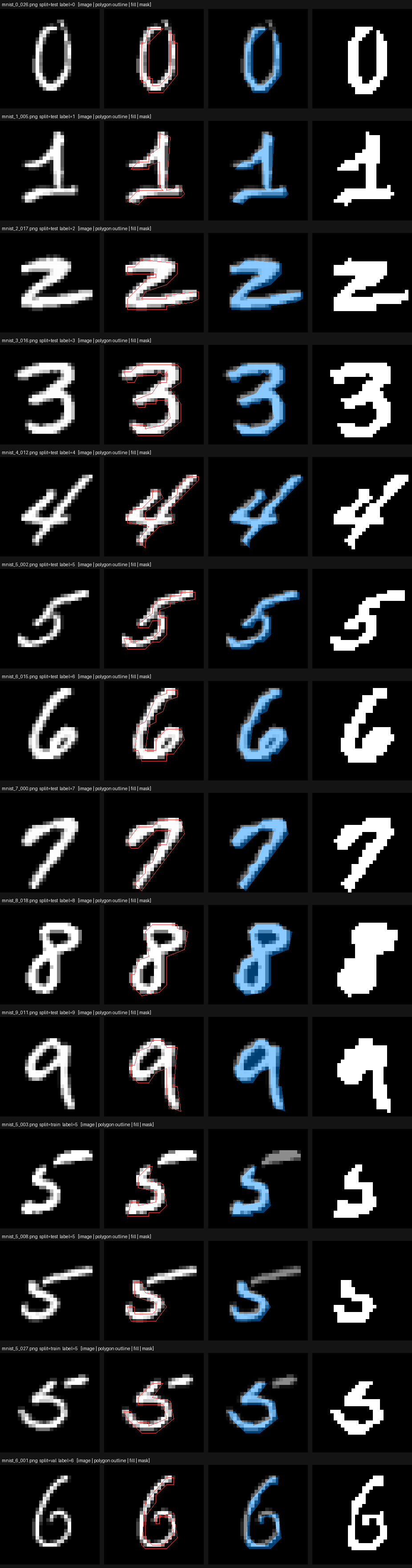
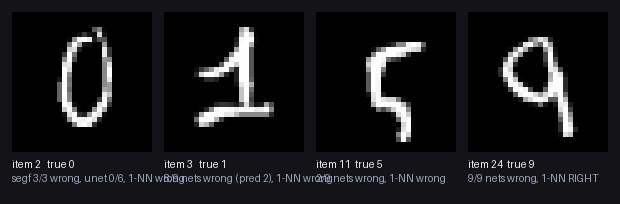
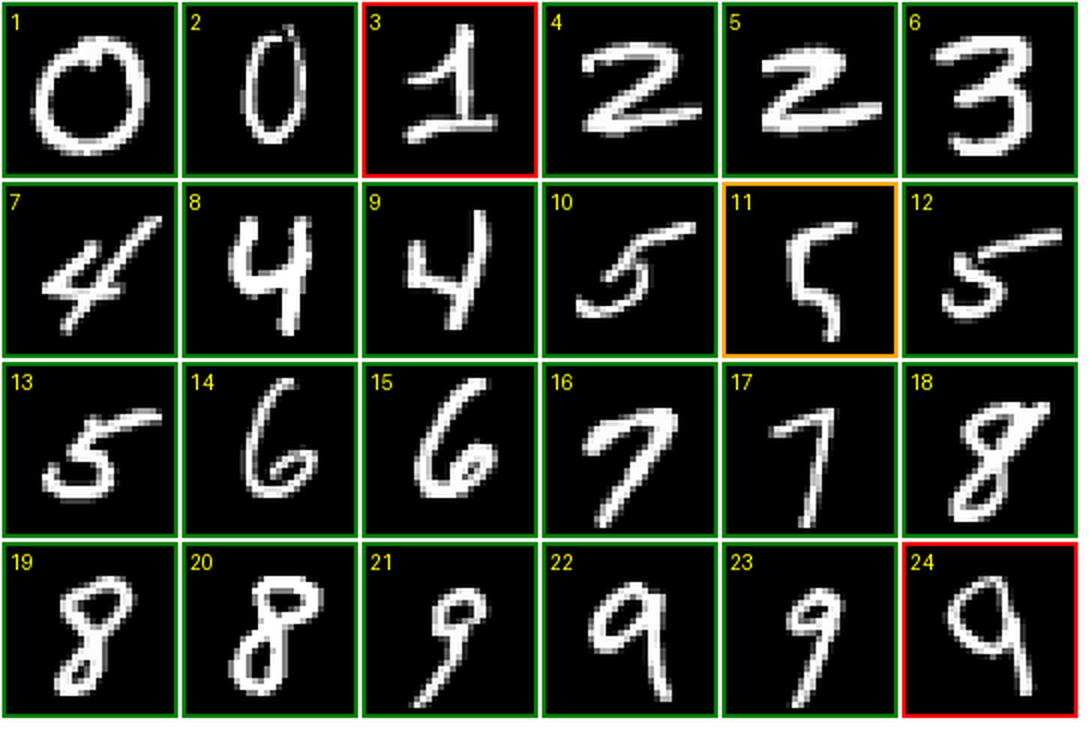
ROUND 2 SETTLED THE LAST QUESTION THIS CUT COULD ANSWER. The pivot was deliberately NOT an architecture ranking -- it was a per-item categorical question. segformer_tiny@1.10.0 (attention, not convolution) at the same converged schedule, three seeds: 0.8750 / 0.7917 / 0.8750 (x2-869f94870301, x2-732c1739b76a, x2-92f2227965a6). h2-ceiling-is-the-data-not-the-model's falsifier was 'it reads BOTH item 3 and item 24 correctly'. It read NEITHER, in all three seeds. Across 9 converged runs spanning two structurally unrelated backbones, three seeds each, two augment values and two class_weighting values: item 24 (mnist_9_026.png) is wrong in 9 of 9, item 3 (mnist_1_005.png) in 8 of 9, and only four other item-slots ever move, each in a single run (find-cross-family-ceiling-nine-runs). I looked at worst.png: strokes traced cleanly, nothing bridged or cropped, the class name wrong under a correct outline -- per-item IoU exactly 0.000 on both.
THE MECHANISM, WHICH WAS NOT IN THE PLAN AND IS THE ROUND'S BEST RESULT. Characterisation measured 1-NN on raw pixels; its three errors are mnist_0_026, mnist_1_005 and mnist_5_005. So 1-NN reads mnist_9_026 CORRECTLY while all nine neural runs miss it. That splits the two-image ceiling in half:
- item 3, mnist_1_005: a 1 whose top flag and full horizontal foot bar make its silhouette a 2. Missed by BOTH neural families AND by nearest neighbour. Genuine ambiguity; no model fixes it.
- item 24, mnist_9_026: a 9 whose closed bowl and stub tail make its FILLED silhouette a 0. Read correctly by raw pixels, missed by every segmentation run. This one is the OBJECTIVE's loss, not the image's: the label policy traces the outer silhouette and fills the interior holes of 0/6/8/9, so the per-pixel target discards exactly the evidence that separates a 9 from a 0. A different backbone cannot recover it; a different TARGET might.
SO THE STUDY PARKS, AND ON FAILURE TO LEARN RATHER THAN FAILURE TO PAY. 9 of 26 runs and 3 of 5 rounds remain; GPU is nowhere near the wall (~40 GPU-minutes of a 7-hour grant). The binding constraint is images. The whole remaining range is 22/24 -> 24/24 = two images; one is missed by every method known here, the other needs a different target rather than a different config. minPracticalEffect is 0.0833 = two images and gradability says 9 runs resolve only 0.20. Every further configuration arm on this cut must come back within_noise -- 11 of 14 graded verdicts already are. Draining the last 9 runs into that is worse than stopping, because it looks like progress. The runs are worth more held for the larger class-stratified scored set that stands on the asks.
WHAT ROUNDS 0-1 ESTABLISHED, CARRIED FORWARD. The schedule was the whole story: the same config went 0.5417 -> 0.9167 from epochs=60 to 400, paired meanDiff +0.375, se 0.1175, t 3.19 -- the study's only better verdict (x1-f37d7c84a6ef vs x0-4775d82bc6b7). The seed sigma of 0.168 that once walled the study at a detectable effect of 0.211 and 65 seeds per arm was an artefact of stopping three still-climbing curves at 60 epochs; at 400 the same three seeds return the SAME NUMBER. Two hypotheses died on their own falsifiers: augment=none scores 0.9167 at seed 1 and 0.8750 at seed 2, both within one image of flip (h0-augment-flip-hurts-digits refuted); class_weighting=inverse_freq returns effect exactly 0.000 with iou FALLING 0.6376 -> 0.5871 (h1-background-dominates-the-loss refuted -- the 97%-background arithmetic was correct and predictively worthless).
WHAT I DECLINE TO BUILD, NOW FOR A MEASURED REASON. A dedicated classifier head. Its trigger under h0-seg-can-classify was a plateau below 0.667 with well-traced silhouettes; the curves plateaued at 0.9167, so the trigger was genuinely testable and did not fire. At best it recovers the one image the objective loses: 0.0417, half of minPracticalEffect and below the one-image resolution floor. If the scored set grows, this becomes the first thing worth building, because the mechanism is now identified rather than guessed.
WHAT ROUND 2 COST ME BEFORE IT PAID. Its first three arms (x2-436cfe7c1085, x2-fd749980898a, x2-666a0b4741ba) died 12 seconds after launch, evidence-free: epochs=600 against a declared range of [1, 400]. Neither declare_experiment nor enqueue refuses an out-of-range numeric value -- the trainer does, after the run is claimed -- so each violation costs a whole run slot for zero GPU-seconds. Three of 26. The min/max live ONLY in /home/jha0006/research/recipes//recipe.json; read_recipes returns type and default. A schedule longer than 400 epochs is legal without a version bump via scalingContract 'steps' with max_steps (max 2000000), at 30 steps/epoch on this cut.
THE SPLIT DEFECT, priced not argued. The human decided to proceed as cut. val holds zero 5s while the scored set holds four; the item that this most plausibly destabilises, item 11 = mnist_5_005.png (a 5 with a detached top bar), moves in exactly 2 of 9 runs. One unstable image out of 24, below the resolution floor and below minPracticalEffect. It weakens selection; it biases no scored number. A larger cut must be class-stratified.
WHAT ENDS THE PARK. A larger, class-stratified labelled set -- a few hundred scored images instead of 24. MNIST is free and the mechanism to chase is already named. With 9 runs still granted, the study can resume the moment the data lands.
Claims
- supported — The user's question is top-1 digit classification, and image_class_accuracy on sc_mnist_digits_b2f34dc3 measures it; IoU is a proxy that cannot see a perfectly traced digit under the wrong class label. Round 1 demonstrates the gap concretely: the two failing items score IoU 0.000 with visually clean silhouettes. (find-char-dsfb7985d4ebd7f9f9, find-two-image-ceiling-same-items-every-config)_
- supported — The instrument is valid on REAL runs, not just at declaration: all eleven runs report oracle_image_class_accuracy 1.0000 and baseline_empty_image_class_accuracy 0.0000 on the scored 24, with per-item vectors the fold used for paired tests and this tick used for the ceiling analysis. (find-recipe-image-class-accuracy-1100, x1-f37d7c84a6ef, x0-4775d82bc6b7, x0-269898940c77, x0-337bc53ade3a, x0-3d975a041094, x0-93418a718b04)
- supported — The 24-image scored set cannot resolve differences between competent models, and round 2 turns that from an argument into a measurement: segformer_tiny vs unet_small at a matched converged schedule is paired meanDiff -0.0833, se 0.0576, t -1.45 -- within noise. The best config sits at 22/24 with 1-NN on raw pixels at 21/24, so the whole remaining range is two images. One image is 0.0417; a paired test needs about five discordant images. 95% Wilson on 22/24 is [0.742, 0.977]. Any future arm scoring 23/24 or 24/24 cannot be separated from a draw. (find-char-dsfb7985d4ebd7f9f9, find-cross-family-ceiling-nine-runs, x1-f37d7c84a6ef, x2-869f94870301, x2-732c1739b76a)_
- supported — The scored set is not contaminated by near-duplicates: groupKey "item" is correct, and no test item's nearest neighbour anywhere exceeds cosine 0.884, all same-class different-writer. (find-char-dsfb7985d4ebd7f9f9)_
- supported — The split is not class-stratified: val holds zero 5s while the scored set holds four. The human decided this tick to proceed as cut, and round 1 prices the defect exactly: the ONLY item that moves between configs is item 11 = mnist_5_005.png, a 5 with a detached top bar -- one unstable image out of 24, below the resolution floor and below minPracticalEffect, changing no verdict. It weakens selection; it biases no scored number. A future larger cut should be class-stratified. (find-char-dsfb7985d4ebd7f9f9, find-two-image-ceiling-same-items-every-config, ask_8b851c96-mtsporyy?)_
- supported — Instance-count metrics have no spread on this data -- every image has exactly one polygon rasterising to exactly one connected component -- so instance_count_mae and count_exact_rate are not candidate objectives here. (find-char-dsfb7985d4ebd7f9f9)_
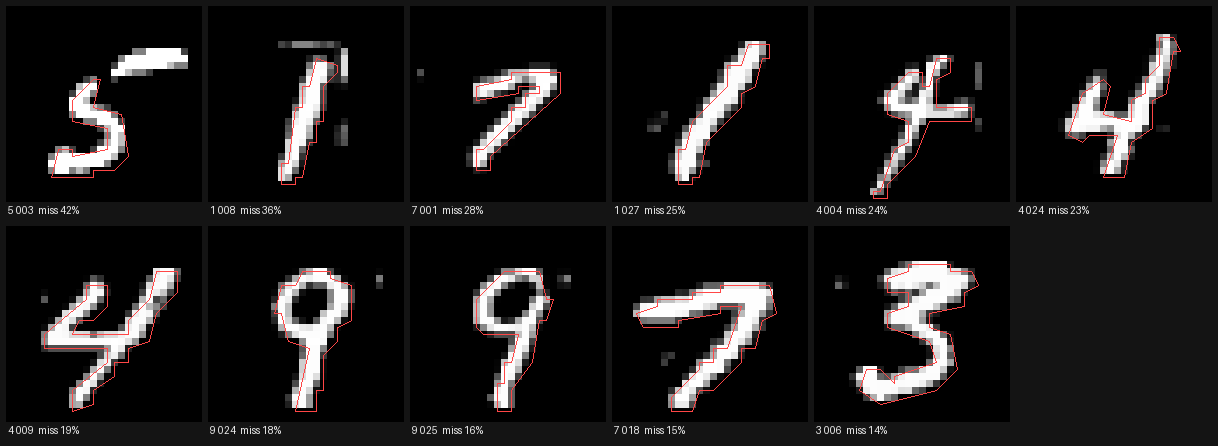
- supported — 11 of 300 images (all in train, none scored) have 14-42% of their ink labelled background because the policy traces only the largest connected component; the class label is correct on all of them. (find-label-detached-strokes)
- supported — A segmentation recipe reaches image_class_accuracy >= 0.833 on this scored set. REACHED: unet_small@1.10.0 at epochs=400 scores 0.9167 (22/24) at seeds 1, 2 and 3 identically, clearing the 1-NN raw-pixel reference (0.875), chance (0.100) and the majority constant (0.167). Round 0's 0.5417/0.6667/0.3333 was a 60-epoch artefact and bore on nothing. (h0-seg-can-classify, x1-f37d7c84a6ef, x1-ca6f1f37d19f, x1-7180c6e0777c, find-round1-converged-at-400-epochs)
- refuted — The recipe default augment=flip is wrong for digits and costs accuracy against augment=none. REFUTED at the converged schedule: augment=none scores 0.9167 at seed 1 (identical to flip) and 0.8750 at seed 2 (one image BELOW flip). Both paired seeds land within one image, which is exactly the falsifier. The +0.125 measured at 60 epochs and the wide val gap were schedule artefacts. The mechanism -- a mirrored 2 is not a 2 -- is sound but does not bind after 96000 samples. (h0-augment-flip-hurts-digits, x1-e07937d67f6c, x1-1d5c76a779f8, x1-f37d7c84a6ef, x1-ca6f1f37d19f)
- refuted — Selecting the checkpoint on val_image_class_accuracy beats selecting on val_iou by at least two images. REFUTED as stated: x0-93418a718b04 returned image_class_accuracy 0.541667 byte-identical to its control, because on a val curve that never turns over both rules keep the final epoch -- one checkpoint scored twice. Round 1 makes this retrospectively clean: once converged, best epochs land at 60-340 of 400 rather than on the last, so the question WOULD now be askable; it is simply not worth buying, because selecting on the objective is free and every arm since does it. (h0-selection-metric-matters, x0-93418a718b04, x0-4775d82bc6b7, find-round0-undertrained-60-epochs, find-round1-converged-at-400-epochs)
- supported — A dedicated classifier recipe is still not worth building ON THIS CUT, now for a measured reason. Its trigger under h0-seg-can-classify was a PLATEAU BELOW 0.667 under well-traced silhouettes; the curves plateaued at 0.9167 and the trigger did not fire. At best such a head recovers the ONE image the objective loses (item 24, which 1-NN on raw pixels already reads): 0.0417, half of minPracticalEffect and below the one-image resolution floor. If the scored set grows to a few hundred images this becomes the FIRST thing worth building, because the mechanism is now identified rather than guessed. (find-round1-converged-at-400-epochs, find-cross-family-ceiling-nine-runs, x1-f37d7c84a6ef, x2-869f94870301)
- supported — The objective was confirmed from the moment set_brief folded (a human grant was already on the study); an earlier tick's report that it awaited confirmation was a misread of its own state, and no run was ever blocked by it. (find-register-recipes-needs-explicit-manifests)
- supported — register_recipes with no arguments registers the route's bundled library, NOT this box's /home/jha0006/research/recipes -- a recipe edited on the box must have its manifest inlined in args.recipes and be read back with read_recipes, because the response's
registeredlist does not say which version landed. (find-register-recipes-needs-explicit-manifests) - supported — Round 0 was undertrained end to end: all four val_iou curves rise monotonically to the epoch-60 cutoff and three of five runs select the LAST epoch. 60 epochs = 1800 steps = 24 GPU-seconds against a 7-GPU-hour grant. No round-0 number describes a converged model, and round 1 confirmed it by moving the same config +0.375. (find-round0-undertrained-60-epochs, x1-f37d7c84a6ef, x0-4775d82bc6b7, x0-269898940c77, x0-337bc53ade3a, x0-3d975a041094, x0-93418a718b04)
- supported — The sigma of 0.168 image_class_accuracy that gradability reported -- walling the study at a detectable effect of 0.211 and demanding 65 seeds per arm -- was an artefact of stopping three still-climbing curves early, not the intrinsic seed noise of this recipe. CONFIRMED: at epochs=400 the same three seeds return 0.9167 / 0.9167 / 0.9167, sigma 0.000, with identical per-item vectors. Every round-0 verdict was graded against a phantom. (find-round1-converged-at-400-epochs, x1-f37d7c84a6ef, x1-ca6f1f37d19f, x1-7180c6e0777c)
- supported — A segmentation U-Net reads these digits far above the floors, and once converged it does so at 0.9167 (22/24) against chance 0.100 and the majority-class constant 0.167. The undertrained round-0 figures (0.5417/0.6667/0.3333) showed the task was learnable by this family; round 1 shows the ceiling too. (x1-f37d7c84a6ef, x1-ca6f1f37d19f, x1-7180c6e0777c, x0-4775d82bc6b7, x0-269898940c77, x0-337bc53ade3a)
- refuted — The per-pixel objective spends about 97% of itself on background, so class_weighting=inverse_freq should raise image_class_accuracy. REFUTED: x1-03dc5648daaa returns 0.9167, effect exactly 0.000 against its matched control, with the same two items failing, while iou FALLS 0.6376 -> 0.5871. The falsifier ('within one image of the control, or below it') fired. The 97%-background arithmetic was correct and predictively worthless. (h1-background-dominates-the-loss, x1-03dc5648daaa, x1-f37d7c84a6ef, find-char-dsfb7985d4ebd7f9f9)_
- supported — My prediction ledger is 8 hits / 6 misses. All five round-0 misses came from pricing a 60-epoch default as a converged schedule. Round 1 went 6 for 6 once I set predictions from curve shape. Round 2 went 2 of 3: the one miss is x2-732c1739b76a, segformer seed 2 at 0.7917 against a predicted >= 0.833 -- I carried unet_small's zero seed sigma across a family change, which was exactly the assumption the run was bought to test. (x1-f37d7c84a6ef, x1-ca6f1f37d19f, x1-7180c6e0777c, x2-869f94870301, x2-732c1739b76a, x2-92f2227965a6)
- supported — The 400-epoch schedule is CONVERGED, unlike round 0's: val_iou over the last eight validations spans 0.006-0.021 in five of six runs, and the selected epoch is 210/90/180/60/340/110 of 400 -- never the last. Checkpoint selection is finally doing work rather than picking wherever the clock stopped. (find-round1-converged-at-400-epochs, x1-f37d7c84a6ef, x1-ca6f1f37d19f, x1-7180c6e0777c, x1-e07937d67f6c, x1-03dc5648daaa, x1-1d5c76a779f8)
- supported — The residual error is two specific images, not a distribution, and this now holds across TWO families: over 9 converged runs (6 unet_small + 3 segformer_tiny, three seeds each, two augment values, two class_weighting values) item 24 (mnist_9_026.png) is misclassified in 9 of 9 and item 3 (mnist_1_005.png) in 8 of 9; only items 2, 11, 16 and 18 ever move, each in a single run. It is a CLASSIFICATION ceiling, not a segmentation one -- both hard items have per-item IoU exactly 0.000 (a correct silhouette under the wrong digit) while the rest score 0.140-0.904, and worst.png shows cleanly traced s (find-cross-family-ceiling-nine-runs, find-two-image-ceiling-same-items-every-config, x1-f37d7c84a6ef, x1-ca6f1f37d19f, x1-7180c6e0777c, x1-e07937d67f6c, x1-03dc5648daaa, x1-1d5c76a779f8, x2-869f94870301, x2-732c1739b76a, x2-92f2227965a6)
- supported — The 0.9167 ceiling on sc_mnist_digits_b2f34dc3 belongs to the images and the objective, NOT to the unet_small family. CLOSED on h2's own falsifier: segformer_tiny@1.10.0 (attention, not convolution) at the same converged epochs=400 schedule reads NEITHER item 3 nor item 24 at any of three seeds, exactly as unet_small does not. Nine converged runs, two structurally unrelated backbones, three seeds each: item 24 wrong 9/9, item 3 wrong 8/9. Re-asking this on this cut buys nothing. (h2-ceiling-is-the-data-not-the-model, x2-869f94870301, x2-732c1739b76a, x2-92f2227965a6, find-cross-family-ceiling-nine-runs)
- supported — A numeric config value outside a recipe manifest's declared range is NOT refused at declare or enqueue -- it is refused by the trainer on the box after the run is claimed, so it costs a full run slot for zero GPU-seconds. Round 2 lost three of a 26-run grant this way (epochs=600 against epochs {min 1, max 400}). The min/max are visible ONLY in /home/jha0006/research/recipes//recipe.json; read_recipes returns type and default only. A schedule longer than 400 epochs is legal without a version bump via scalingContract 'steps' with max_steps (max 2000000), at 30 steps/epoch on this cut. (find-round2-died-on-epochs-range-contract, x2-436cfe7c1085, x2-fd749980898a, x2-666a0b4741ba)
- supported — THE TWO-IMAGE CEILING SPLITS IN HALF, and only one half is about the data. Characterisation's 1-NN on raw pixels errs on mnist_0_026, mnist_1_005 and mnist_5_005 -- it reads mnist_9_026 CORRECTLY, where all nine neural runs miss it. So item 3 (mnist_1_005, a 1 whose top flag and full foot bar make its silhouette a 2) is genuine ambiguity that no method here reads; item 24 (mnist_9_026, a 9 whose closed bowl and stub tail make its FILLED silhouette a 0) is a loss of the per-pixel filled-polygon OBJECTIVE, whose label policy fills the interior holes of 0/6/8/9 and therefore discards the evidence (find-cross-family-ceiling-nine-runs, find-char-dsfb7985d4ebd7f9f9, x2-869f94870301, x2-92f2227965a6, x1-f37d7c84a6ef)_
- supported — segformer_tiny is the LESS STABLE family on this cut and cannot be ranked against unet_small here. Three seeds at epochs=400 give 0.8750 / 0.7917 / 0.8750, sigma 0.0481 -- above the one-image floor of 0.0417, so that half of its own falsifier fired -- against unet_small's 0.9167 / 0.9167 / 0.9167 at sigma 0.000. Paired against seed 1 the spread is meanDiff -0.0833, se 0.0576, t -1.45: within noise. Both segformer curves are converged (val_iou spans 0.016 / 0.007 / 0.028 over the last eight validations; best epochs 250 / 220 / 80 of 400), so the schedule is not the explanation. The per-item cla (x2-869f94870301, x2-732c1739b76a, x2-92f2227965a6, find-cross-family-ceiling-nine-runs)
- supported — THE STUDY PARKS ON FAILURE TO LEARN, NOT ON BUDGET. 9 of 26 runs and 3 of 5 rounds remain and GPU is at roughly 40 minutes of a 7-hour grant, but no configuration arm on sc_mnist_digits_b2f34dc3 can produce a gradable result: minPracticalEffect is 0.0833 = two images, gradability puts the smallest resolvable effect at 0.20 with the runs left, 11 of 14 graded verdicts are already within_noise, and the entire remaining headroom is the two images that 9 runs across 2 families all miss. The one act that changes this is a larger, class-stratified scored set; the remaining 9 runs are held for it. (find-cross-family-ceiling-nine-runs, find-two-image-ceiling-same-items-every-config, find-char-dsfb7985d4ebd7f9f9)_
An id marked ?* is cited by the claim but is not on the graph or in its archive.*
Open questions
- Does a classification head on top of the segmentation trunk recover mnist_9_026 (the image 1-NN on raw pixels reads and every segmentation run misses)? Unanswerable on 24 images -- one image is half of minPracticalEffect -- but the FIRST thing to buy on a larger scored set, because the mechanism (the label policy fills interior holes, erasing what separates a 9 from a 0) is now identified rather t
- Does the unet_small vs segformer_tiny gap (meanDiff -0.0833, within noise on 24 images) survive on a few hundred images, or is it a two-image accident?
- Is unet_small's exactly-zero seed sigma a property of the recipe or of this tiny cut? segformer_tiny at the same schedule gives 0.0481, so it is not a property of the schedule alone.
- Does a class-stratified split (val currently holds zero 5s) change checkpoint selection enough to move item 11 = mnist_5_005.png, the only item that moves for schedule-independent reasons?
Next best experiments
- NOTHING on this cut. Every remaining configuration arm must return within_noise: the headroom is two images, minPracticalEffect is two images, and the resolvable effect with 9 runs is 0.20. Hold the 9 runs.
- A larger, CLASS-STRATIFIED labelled MNIST cut (a few hundred scored images). MNIST is free; this is the only act that raises the study's resolution, and it makes every question above answerable with the runs already granted.
- IF the data grows: a classification head or an auxiliary class loss on the segmentation trunk, aimed at the objective-loss half of the ceiling (item 24). Buildable in plain PyTorch under the recipes skill, no human capability needed.
- IF the data grows: re-run the segformer_tiny vs unet_small comparison at three seeds each on the larger scored set, which is where a two-image difference becomes a measurable one.
Can this data answer it?
Target: 5: 0.17 ± 0.38 per item (scored set) · constant-predictor MAE 0.17.
Split: 7 pair(s) of near-identical pictures sit on opposite sides of the split (closest: mnist_digits/mnist/mnist_0_001.png ↔ mnist_digits/mnist/mnist_0_016.png). If those are one object photographed twice, a score over them measures recall, not generalisation — put them in one group, or drop one.
σ = 0.1 image_class_accuracy (9 seed replicates in 3 groups). Detecting 0.083 needs 24 seeds per arm at 80 % power. The 9 runs left seat 4 per arm, which can only resolve 0.2. Either accept 0.2 as the smallest effect worth acting on, reduce the noise (a lower-variance metric, a longer schedule, a bigger scored set), or extend the budget.
Best so far
- x1-f37d7c84a6ef — LONG CALIBRATION control — the round-0 control config at epochs=400, seed 1 (one knob: epochs 60 -> 400): image_class_accuracy 0.92 · better · paired Δ 0.38 (n=24, t=3.19) · seed spread ÷1000000 · predicted image_class_accuracy >= 0.708 → held
unet_small@1.10.0 · 11 classes · train 240 / val 36 · epochs: 400 ep, 12000 steps, 96000 samples · cuda, 147 GPU-s · decode components · best ep 210 (val_image_class_accuracy 0.9722) · sc_mnist_digits_b2f34dc3 iou 0.6376 (n=24)
- x1-ca6f1f37d19f — LONG CALIBRATION seed 2 — identical config to x1-f37d7c84a6ef: image_class_accuracy 0.92 · within noise · paired Δ 0 (n=24, t=0) · predicted image_class_accuracy >= 0.708 → held
unet_small@1.10.0 · 11 classes · train 240 / val 36 · epochs: 400 ep, 12000 steps, 96000 samples · cuda, 139 GPU-s · decode components · best ep 90 (val_image_class_accuracy 1.0) · sc_mnist_digits_b2f34dc3 iou 0.5878 (n=24)
- x1-7180c6e0777c — LONG CALIBRATION seed 3 — identical config to x1-f37d7c84a6ef (the slow seed of round 0): image_class_accuracy 0.92 · within noise · paired Δ 0 (n=24, t=0) · predicted image_class_accuracy >= 0.708 → held
unet_small@1.10.0 · 11 classes · train 240 / val 36 · epochs: 400 ep, 12000 steps, 96000 samples · cuda, 138 GPU-s · decode components · best ep 180 (val_image_class_accuracy 0.9444) · sc_mnist_digits_b2f34dc3 iou 0.6156 (n=24)
- x1-e07937d67f6c — augment=none at the long schedule, seed 1 — one knob against x1-f37d7c84a6ef: image_class_accuracy 0.92 · within noise · paired Δ 0 (n=24, t=0) · predicted image_class_accuracy >= 0.75 → held
unet_small@1.10.0 · 11 classes · train 240 / val 36 · epochs: 400 ep, 12000 steps, 96000 samples · cuda, 138 GPU-s · decode components · best ep 60 (val_image_class_accuracy 1.0) · sc_mnist_digits_b2f34dc3 iou 0.7547 (n=24)
- x1-03dc5648daaa — EXPLORATION — class_weighting=inverse_freq at the long schedule, seed 1, one knob against x1-f37d7c84a6ef: image_class_accuracy 0.92 · within noise · paired Δ 0 (n=24, t=0) · predicted image_class_accuracy >= 0.708 → held
unet_small@1.10.0 · 11 classes · train 240 / val 36 · epochs: 400 ep, 12000 steps, 96000 samples · cuda, 135 GPU-s · decode components · best ep 340 (val_image_class_accuracy 0.8889) · sc_mnist_digits_b2f34dc3 iou 0.5871 (n=24)
- x1-1d5c76a779f8 — augment=none at the long schedule, seed 2 — one knob against x1-ca6f1f37d19f: image_class_accuracy 0.88 · within noise · paired Δ -0.042 (n=24, t=-1) · predicted image_class_accuracy >= 0.75 → held
unet_small@1.10.0 · 11 classes · train 240 / val 36 · epochs: 400 ep, 12000 steps, 96000 samples · cuda, 133 GPU-s · decode components · best ep 110 (val_image_class_accuracy 1.0) · sc_mnist_digits_b2f34dc3 iou 0.6362 (n=24)
- x2-869f94870301 — CEILING ATTRIBUTION (re-buy at a legal schedule) — segformer_tiny, epochs=400, seed 1: does an attention family miss the SAME two images?: image_class_accuracy 0.88 · ungraded · ungraded: no control · predicted image_class_accuracy >= 0.833 → held
segformer_tiny@1.10.0 · 11 classes · train 240 / val 36 · epochs: 400 ep, 12000 steps, 96000 samples · cuda, 289 GPU-s · decode components · best ep 250 (val_image_class_accuracy 0.9722) · sc_mnist_digits_b2f34dc3 iou 0.5469 (n=24)
- x2-92f2227965a6 — CEILING ATTRIBUTION seed 3 — identical config to x2-869f94870301 (segformer_tiny, epochs=400): image_class_accuracy 0.88 · within noise · paired Δ 0 (n=24, t=0) · predicted image_class_accuracy >= 0.833 → held
segformer_tiny@1.10.0 · 11 classes · train 240 / val 36 · epochs: 400 ep, 12000 steps, 96000 samples · cuda, 293 GPU-s · decode components · best ep 80 (val_image_class_accuracy 0.8889) · sc_mnist_digits_b2f34dc3 iou 0.5494 (n=24)
What was learned
- The per-pixel objective spends almost all of itself on background: the snapshot profile gives each digit class 0.87%-2.98% of the pixels, so with class_weighting=none about 97% of every cross-entropy term is background and the ten digit identities — the only thing image_class_accuracy reads — compete over the remaining 3%. class_weighting=inverse_freq therefore raises image_class_accuracy on sc_mnist_digits_b2f34dc3 by at least 0.0833 against a matched control at the same seed and schedule. FALSIFIER: it lands within one image of the matched control, or below it — the dice half of ce_dice was → inconclusive on sc_mnist_digits_b2f34dc3 (Δ 0)
Predictions: 8 held, 6 missed.
What the study asks of you
- Label more data: A larger, CLASS-STRATIFIED labelled MNIST cut -- a few hundred scored images instead of 24. This is the only act that changes what the study can conclude, and it is the condition that ends the park. Why now: the converged model scores 22/24 and 1-NN on raw pixels scores 21/24, so the whole remaining range is TWO images; both are missed by every one of nine converged runs spanning two structurally unrelated backbones, three seeds each, two augment values and two class_weighting values (mnist_1_005.png, a 1 whose top flag and foot bar make its silhouette a 2; mnist_9_026.png, a 9 whose closed bo
- Decide: The study has answered your question on this cut and can no longer learn from it. Which do you want? ((A) Supply a larger class-stratified scored set (a few hundred images) and I resume with the 9 runs still granted -- fir / (B) Accept 0.20 image_class_accuracy (five images) as the smallest effect worth acting on and I will spend the 9 runs ra / (C) Close the study as done at 22/24. The answer is delivered and cross-validated: unet_small@1.10.0, epochs=400, image_)
Figures
THE CEILING IS THE DATA AND THE OBJECTIVE, NOT THE unet_small FAMILY -- 9 converged runs, 2 structurally different backbones, one table. I read the per-item image_class_accuracy vectors out of result.json for all six round-1 unet_small run (x2-869f94870301)
THE CEILING IS THE DATA AND THE OBJECTIVE, NOT THE unet_small FAMILY -- 9 converged runs, 2 structurally different backbones, one table. I read the per-item image_class_accuracy vectors out of result.json for all six round-1 unet_small run (x2-869f94870301)
THE RESIDUAL ERROR IS NOT SPREAD OVER THE SCORED SET -- IT IS THE SAME TWO IMAGES IN EVERY CONFIG. I pulled the per-item image_class_accuracy vector out of all six round-1 result.json files. . = read correctly, X = wrong class: x1-f3
11 of 300 images carry more than one 8-connected ink component, and the labelling policy traces only the LARGEST one — so part of the digit's ink is labelled background. All 11 are in the train split; none is scored. Ink outside the polygon
By round
Round 0 · tick-40517497f1b15d6e · 2026-09-08 13:06
PHASE 0 — characterised snapshot ds_fb7985d4ebd7f9f9 and proposed the objective; nothing enqueued, by design. I verified all 600 sha256s, measured all 300 images and polygons with code, and looked at the renders (overlays, the 24 scored digits, the 11 detached-stroke labels). The user's sentence is 'name the digit', so the metric is top-1 accuracy — and no recipe logged it. Rather than optimise IoU because IoU was there, I BUILT image_class_accuracy into the mirrored metrics block of unet_small@1.10.0 and segformer_tiny@1.10.0 (declared metric, curve, selection-metric value, per-item scores for paired comparison, new unit test recipes/shared/testimage_class.py; both self-tests PASS; oracle 1.0000 on 24/24 of the real scored set, empty baseline 0.0000) and registered both. The honest headline: 1-NN on RAW PIXELS already scores 21/24 = 0.875 on the sealed set, one image is 4.17 points, and a paired test over 24 items needs ~5 discordant images to call an effect — so this cut can show that a model reads these digits and can catch a broken one, but cannot rank two competent architectures. Objective proposed, four hypotheses declared, three findings posted. Awaiting the human's confirmation — nothing may run before it.
- set aside Make IoU the primary metric because both recipes already log it — The polygon is a carrier for the class and its silhouette is nearly the same for every digit, so IoU cannot see a perfectly traced 1 called a 7 — the only failure the user cares about. Kept as an unga
- set aside File a recipe request for an accuracy metric and park until a human builds it — Under the recipes skill a metric the study needs is mine to build. It is one general addition to the mirrored block, it self-tests, and requesting it would have cost the study a whole round of waiting
- set aside Build a dedicated classifier recipe now — The segmentation recipes can express the task and now measure it exactly. A third family buys no resolving power against a 24-image set that 1-NN answers at 0.875. Held as the diagnosed fix under h0-s
- set aside Re-declare the source with a different groupKey and re-cut — groupKey "item" is correct. The snapshot's 7 flagged cross-split near-duplicates are all same-class different-writer train<->val, and no test item's nearest neighbour anywhere exceeds cosine 0.884. Th
- set aside Make instancecount_mae or count_exact_rate the objective_ — No spread: every one of the 300 images has exactly one polygon rasterising to exactly one connected component. Optimising a constant would test memorising, not counting.
- set aside Put a guardrail on IoU — It would reject a model for failing at something the user did not ask for, on a tracing that is itself inconsistent class to class (interior holes filled on 8/9, open on some 0s, mean precision 0.822)
- set aside Block the study on re-cutting a class-stratified split — val holding zero 5s weakens checkpoint selection but biases no scored number. Cheaper to proceed and select on val_image_class_accuracy; the choice is on the asks as a decision for the human.
- walls: Budget granted: 5 rounds, 26 runs, 7 GPU-hours, $80 tokens; $4.8 spent this tick, 0 runs, 0 GPU-hours. The binding wall is not money — it is the 24-image scored set, whose resolution floor is two images (0.0833) and whose useful range above the 1-NN reference is three.
Round 0 · tick-05698431a5194bc7 · 2026-09-08 13:14
Integrated the four unconsumed findings and bought round 0 — the study's first runs. The decisive one was find-register-recipes-needs-explicit-manifests: the objective has been CONFIRMED all along (set_brief folded to objectiveConfirmed:true under the existing human grant), so the previous tick's park on ask_3c8e581b was a misread of its own state and nothing was ever blocked. Verified against overview before planning: objectiveConfirmed true, grant 5 rounds / 26 runs / 7 GPU-h / $80, 0 experiments, gradability no_sigma. NOTHING WAS WITHDRAWN because nothing was queued — counts showed 0 queued, 0 running, 0 done, so the new evidence had no standing arm to refute. Enqueued 5: three seeds of one byte-identical unet_small@1.10.0 config for the sigma (without it every verdict in this study reads ungraded), plus two single-knob arms against that same control at a shared seed. 21 runs remain.
- chose x0-4775d82bc6b7 — CALIBRATION control, seed 1, run as a SESSION rather than direct: first run of the family on a recipe this study modified last tick, so I want an agent reading the previews and describing a failure in
- chose x0-269898940c77 — CALIBRATION seed 2, byte-identical config, direct. gradability reports no_sigma and a sigma needs three seeds of ONE configuration.
- chose x0-337bc53ade3a — CALIBRATION seed 3, byte-identical config, direct — the run that turns two numbers into a sigma.
- chose x0-3d975a041094 — EXPLORATION slot: augment=none, one knob against the control at the same seed. The manifest defines
flipas horizontal AND vertical flip, so the default teaches upside-down 6s and mirrored 5s under - chose x0-93418a718b04 — INSTRUMENT check: selection_metric=val_iou, one knob at the same seed, where both arms share one training trajectory and only the kept epoch differs. Cheapest possible test of whether the metric built
- set aside Park again on ask3c8e581b (confirm the objective)_ — It is already confirmed — objectiveConfirmed:true on overview. Parking a second tick on an answered question would have cost a day's wall clock for nothing.
- set aside segformertiny against unet in round 0_ — Unreadable by construction until a sigma exists: 1-NN on raw pixels already scores 0.875 on these 24 images and a paired sign test needs about five discordant images. Reporting an architecture winner
- set aside Wait for the larger scored set before running anything — Nothing in round 0 depends on it. A seed sigma and a correctness bug in the default augmentation are both readable at n=24; only the architecture ranking is not.
- set aside Re-cut the snapshot class-stratified first — The missing 5s in val weaken checkpoint SELECTION but bias no scored number. A re-cut costs a tick plus re-characterisation for a selection-only gain; selecting on val_image_class_accuracy is the chea
- set aside Build the global-pooled classifier recipe now — It buys no resolving power on a 24-image set 1-NN answers at 0.875. Held as the diagnosed fix under h0-seg-can-classify's falsifier — built only if the trio plateaus below 0.667 while the previews sho
- set aside Pin contentbias explicitly_ — image_size resolves to 64 (the manifest minimum) while the images are 28x28, so the whole picture fits one window and there is no crop to place — the knob cannot act here. Left at its profile-derived
- read 4 finding(s): find-char-ds_fb7985d4ebd7f9f9, find-recipe-image-class-accuracy-1100, find-label-detached-strokes, find-register-recipes-needs-explicit-manifests
Round 1 · tick-23e5186adfd64df5 · 2026-09-08 13:40
Round 0 closed and round 1 enqueued. Reading the five results from the archive rather than the graph changed what round 0 means: every val_iou curve is still rising at the epoch-60 cutoff (0.010->0.366, 0.016->0.352, 0.027->0.152, 0.012->0.566) and three of five runs pick the LAST epoch as best. 60 epochs is 1800 steps and 24 GPU-seconds against a 7-GPU-hour grant — nothing converged, so the sigma of 0.168 the fold now grades against is the spread of three curves cut early, not this recipe's seed noise. The selection-metric arm is worse than null: both rules kept epoch 60, so it scored one checkpoint twice. WITHDRAWN: nothing — round 0 had zero queued and zero running arms when this tick opened; all five had already finished, so there was no card to redirect. Round 1 re-asks every round-0 question at epochs=400 (max_steps=40000 so it does not bind): a three-seed calibration to re-measure sigma at the schedule it will grade, augment=none at two paired seeds, and class_weighting=inverse_freq as the exploration slot. Six runs, roughly 16 GPU-minutes, against 2 GPU-minutes spent so far.
- chose x1-f37d7c84a6ef — LONG CALIBRATION control at seed 1 — a single-knob change (epochs 60->400) against x0-4775d82bc6b7, so the schedule itself gets a verdict; run as a SESSION because the first run of a new schedule is t
- chose x1-ca6f1f37d19f — Seed 2 of that identical config — without a sigma measured at the schedule round 1 is graded on, every round-1 verdict would be scored against round 0's artefact.
- chose x1-7180c6e0777c — Seed 3, the outlier of round 0 (val_iou 0.152, accuracy 0.333) whose curve was climbing exactly like the others; this arm decides whether that gap was a slow seed or a bimodal recipe.
- chose x1-e07937d67f6c — augment=none at seed 1 against the long control — flip is horizontal AND vertical, and at 60 epochs none already reached val_image_class_accuracy 0.8611 against the control's 0.5556.
- chose x1-1d5c76a779f8 — augment=none at seed 2, paired against the long control at the same seed — one seed cannot separate a knob from a draw; two paired seeds moving the same way can.
- chose x1-03dc5648daaa — EXPLORATION slot: class_weighting=inverse_freq, the only untested knob with a mechanism — each digit class covers 0.87%-2.98% of pixels, so ~97% of the cross-entropy is background while image_class_ac
- set aside Re-test selectionmetric=val_iou vs val_image_class_accuracy at the long schedule_ — Round 0 showed both rules keep the same epoch when the curve never turns over; c_1766acc9 is refuted as stated and selecting on the objective costs nothing, so every round-1 arm just does it rather th
- set aside segformertiny at any config_ — c_52e52bd0: with 1-NN at 0.875 and one image worth 0.0417, an architecture ranking on 24 images is noise reported as a result. Deliberately unbought until the scored set grows.
- set aside Build the dedicated classifier head — It is the diagnosed fix under h0-seg-can-classify's falsifier, and that falsifier did NOT fire — it requires a plateau below 0.667 and nothing plateaued. Building it now would be treating an undertrai
- set aside Accept 0.211 as the smallest effect worth acting on, as gradability suggests — That sigma is an artefact of stopping early. Accepting it would wall the study at a number produced by a bug in my own schedule.
- set aside Spend the exploration slot on lr or capacity (basechannels/depth)_ — Both are worth buying, but only once effects are gradable; neither has a mechanism as sharp as a 97%-background loss on a metric that reads only the foreground.
- set aside Withdraw or re-run any round-0 arm — Nothing was queued or running — all five finished before this tick opened. The round-0 runs stay on the graph as evidence about the 60-epoch schedule, which is exactly what they are.
- walls: Grant 5 rounds / 26 runs / 7 GPU-hours / $80. Spent: 5 runs, 122 GPU-SECONDS, round 0 of 5. After round 1: 11 runs used, 15 left, ~18 GPU-minutes used of 7 hours. Compute is nowhere near binding; the binding wall is the 24-image scored set and, until round 1 reports, a seed sigma of 0.168 that I believe is an artefact.
Round 2 · tick-cf6a6cff657de6be · 2026-09-08 13:54
Woken for an unappraised hint; found round 1 also complete (6/6 done) and closed it. APPRAISED the human's decision (ask_8b851c96-mtsporyy, proceed on ds_fb7985d4ebd7f9f9 as cut) and acted on it in this tick: no re-cut arm declared, and round 1 lets me price the defect at exactly one image rather than argue it -- val holds zero 5s and the single item that moves between configs is item 11 = mnist_5_005.png, a 5. ROUND 1 CONFIRMED THE UNDERTRAINING DIAGNOSIS: epochs 60 -> 400 moved the same config 0.5417 -> 0.9167 image_class_accuracy (paired +0.375, t 3.19, the fold's first better), the curves now plateau, and the three-seed sigma fell from 0.168 to 0.000. Six of six predictions hit. Two hypotheses died on their own falsifiers: augment=flip does NOT hurt at a converged schedule (none scores 0.9167/0.8750 against flip's 0.9167/0.9167 -- within one image at both paired seeds) and class_weighting=inverse_freq lands at effect exactly 0.000 with iou falling. THE TICK'S REAL FIND, from the archive: the residual error is the SAME TWO IMAGES in every config -- item 24 wrong in 6 of 6, item 3 in 5 of 6, both with per-item IoU exactly 0.000 (clean silhouette, wrong digit) while the other 22 score 0.140-0.904. I rendered the scored 24 and looked: both are genuinely ambiguous glyphs. Headroom is 2 images = 0.0833, exactly minPracticalEffect. Round 2 therefore buys the last question this cut can answer -- three segformer_tiny seeds at epochs=600, read PER-ITEM as ceiling attribution, explicitly not as an architecture ranking the 24 images cannot resolve.
- chose x2-436cfe7c1085 — segformer_tiny seed 1, epochs=600, runner=session: first run of a new family, so the previews and curve shape get described rather than summarised, and epochs deliberately above unet's converged 400 b
- chose x2-fd749980898a — seed 2, byte-identical: a claim about a failure SET from one seed is worth nothing; this and seed 3 give the family's own sigma the way round 1 gave unet's (which came out 0.000).
- chose x2-666a0b4741ba — seed 3, completing the trio that decides h2 -- if all three miss item 24, the ceiling belongs to two ambiguous glyphs and the study closes on evidence rather than on budget.
- set aside Any further unetsmall knob sweep (image_size, base_channels, depth, dropout, lr, loss=ce, flip_rot)_ — Six configs at three seeds returned sigma 0.000 and the same two failures; with 0.0833 of headroom and a 0.0417 resolution floor, no sweep on this cut can produce a gradable result -- it would look li
- set aside Running segformertiny as an architecture COMPARISON against unet_small_ — The whole remaining range is two images, so ranking two competent families here is not honest. The same runs are bought instead as a per-item categorical question, which 24 items can actually answer.
- set aside Building a dedicated classifier head — Its trigger under h0-seg-can-classify was a plateau BELOW 0.667 with well-traced silhouettes. The curves finally plateaued -- at 0.9167, above the 1-NN reference -- so the trigger is now testable and
- set aside Re-cutting the snapshot class-stratified — The human decided this tick to proceed as cut, and round 1 shows the defect is worth exactly one unstable image (item 11, a 5) -- below the resolution floor and below minPracticalEffect. A future larg
- set aside Re-asking selectionmetric now that curves turn over_ — It would finally be askable (best epochs are 60-340 of 400, no longer the last), but selecting on the objective is free and every arm already does it. Nothing to buy.
- set aside Parking the study now — Tempting -- the question is essentially answered at 22/24 -- but one genuinely answerable question remains (ceiling attribution) and it costs ~10 GPU-minutes of a 7-hour grant. Parking before spending
- walls: Budget is not the constraint: 11 runs done + 3 queued of 26, and roughly 0.3 of 7 GPU-hours spent. The binding wall is the 24-image scored set. Sigma at the converged schedule is 0.000, so noise is no longer the problem -- HEADROOM is: 2 images = 0.0833 separates the current best from perfect, and one image is 0.0417. After round 2 this study should close, because no further spend on this cut can resolve anything.
- read 1 finding(s): find-round0-undertrained-60-epochs
Round 2 · tick-92fbfaa28c22a6c1 · 2026-09-08 14:00
Integrated the two round-1 findings (they were posted after the last tick's readThrough, so they woke this one; both were already reflected in the synthesis I wrote from them). The real work of this tick was the state of round 2: ALL THREE segformer_tiny arms are infra_failed, dead 12 seconds after launch with 'epochs=600 is outside the declared range [1, 400]' -- failureClass contract, 0.0 GPU-seconds, no metrics. I read the manifest on the box (/home/jha0006/research/recipes/segformer_tiny/recipe.json: epochs {min 1, max 400}, identical in unet_small) and confirmed this is NOT a recipe defect: the trainer enforced its own contract correctly and the defect was mine at declaration. It cost three run slots (runsLeft 15 -> 12 of 26) for zero evidence, because the range wall fires on the box after the run is claimed, not at declare or enqueue. Re-bought the same three arms at epochs=400 -- the range maximum, and exactly the schedule at which unet_small converged in round 1 -- so the family comparison is now matched on schedule rather than confounded by it. Nothing to withdraw: queued 0, running 0; the three arms this tick would have re-checked against the new evidence were already dead, and the new evidence does not touch their premise (h2's motivation IS the two-image finding). Posted find-round2-died-on-epochs-range-contract with the operational rule: read paramSpec min/max from the file on disk before declaring any non-default numeric value, because read_recipes returns only type and default.
- chose x2-869f94870301 — segformer_tiny seed 1 at epochs=400 -- the re-buy of the arm that died on the contract; asks the per-item categorical question (does an attention backbone miss the same two glyphs?) at the schedule un
- chose x2-732c1739b76a — seed 2, identical config -- the new family needs its OWN seed sigma; unet_small's 0.000 is a fact about unet_small.
- chose x2-92f2227965a6 — seed 3, identical config -- three draws are what make a per-item failure set a claim rather than an anecdote.
- set aside Bump segformertiny to a new version widening epochs to 600_ — A recipe defect is mine to fix, but this is not one: the manifest is the contract and the trainer honoured it. A longer schedule is already legal via scalingContract 'steps' with max_steps (max 200000
- set aside Re-buy at 600 epochs under scalingContract 'steps' (maxsteps=18000) as originally intended_ — epochs=400 is where unet_small converged (best epochs 60-340 of 400, val_iou spread 0.006-0.021 over the last eight validations) and matching the schedule makes the family the only difference. If segf
- set aside runner: session for the first run of the new family — The failure this family already had is caught at declaration now, and a watching agent costs ~$1 and two minutes a run. I can read the val curve and per-item vectors out of the archive myself next tic
- set aside Withdraw round-2 arms in light of the new findings — There were none to withdraw -- queued 0, running 0, all three already infra_failed. And the new evidence is what MOTIVATES h2, not what refutes it.
- set aside Build a dedicated classifier head — Its trigger was a plateau below 0.667 with clean silhouettes; the curves plateaued at 0.9167. Chasing two images that six configs all get wrong is what the one-image resolution floor forbids.
- set aside Any further unetsmall knob arm_ — augment and class_weighting are both refuted at the converged schedule with effects of 0.000-0.042, and the entire remaining headroom is two images = minPracticalEffect. No knob in either manifest mov
- walls: 26-run grant: 14 consumed (11 with evidence, 3 burned on the contract error), 3 queued, 9 left. Round 2 of 5. GPU is not binding -- 11 real runs cost well under 30 GPU-minutes of a 7-hour grant. The binding wall is the 24-image scored set: one image is 0.0417 and a paired test needs ~5 discordant images, so no architecture ranking is honest here whatever segformer scores.
- read 2 finding(s): find-round1-converged-at-400-epochs, find-two-image-ceiling-same-items-every-config
Round 2 · tick-3ad0663b098208d4 · 2026-09-08 14:12
ROUND 2 CLOSED. Integrated the three re-bought segformer_tiny arms (x2-869f94870301 0.8750, x2-732c1739b76a 0.7917, x2-92f2227965a6 0.8750 at epochs=400, three seeds) and the unconsumed anomaly find-round2-died-on-epochs-range-contract. h2-ceiling-is-the-data-not-the-model is settled on its own falsifier: it required segformer to read BOTH item 3 and item 24 correctly; it read NEITHER at all three seeds. I pulled the per-item vectors out of result.json for all 9 converged runs across both families and lined them against the sealed 24-item order: item 24 (mnist_9_026.png) wrong 9/9, item 3 (mnist_1_005.png) wrong 8/9, nothing else stable (find-cross-family-ceiling-nine-runs). I opened worst.png and rendered the four hard items -- strokes cleanly traced, wrong class name over a correct outline, per-item IoU 0.000. The unplanned result: 1-NN on raw pixels reads mnist_9_026 CORRECTLY, so that half of the ceiling is the per-pixel filled-polygon objective (the label policy fills interior holes, erasing what separates a 9 from a 0), not the image; mnist_1_005 is missed by every method including 1-NN and IS genuine ambiguity. Wrote chapter-r2, rewrote the synthesis, carried the claims ledger forward to 25 claims. Nothing was queued or running, so nothing needed withdrawing. Declared and enqueued NOTHING: parking is the honest move and the 9 remaining runs are worth more held for a larger scored set.
- set aside Withdraw queued arms in light of the new evidence (the tick's standing instruction) — There were none: queued 0, running 0. All three round-2 arms had already completed before this tick woke, so there was no card to redirect.
- set aside Spend the remaining 9 runs on untested unetsmall capacity knobs (base_channels 32, depth 5, image_size 128)_ — Every one must come back within_noise. The headroom is two images = 0.0833 = exactly minPracticalEffect, and gradability says 9 runs resolve only 0.20. Draining the grant into inconclusive nodes is wo
- set aside Re-buy segformertiny at a longer schedule under scalingContract 'steps' (max_steps=18000+)_ — Its curves are already converged -- val_iou spans 0.016 / 0.007 / 0.028 over the last eight validations, best epochs 250 / 220 / 80 of 400. The falsifier clause that would have required this did not f
- set aside Build a dedicated classifier head to recover item 24, the image the objective loses — It targets ONE image = 0.0417, half of minPracticalEffect and below the one-image resolution floor. It becomes the first thing worth building the moment the scored set grows, and the synthesis says so
- set aside Run a kind=evaluate arm on the saved checkpoints over decode knobs (mincomponent_px, instance_decode)_ — Free in run-wall terms but zero expected information: all three stable failures have per-item IoU exactly 0.000, i.e. the whole component carries the wrong CLASS. No decode or post-processing knob rea
- set aside Declare a third architecture family for a broader ranking — 24 images cannot rank two competent families -- round 2 measured that rather than argued it (paired meanDiff -0.0833, se 0.0576, t -1.45). A third would add a third unrankable number.
- walls: runs 17/26 consumed (14 with evidence, 3 burned evidence-free on the epochs range contract), 9 left; round 2 of 5; GPU ~40 min of 7 h -- so neither runs nor GPU is the binding wall. IMAGES are: 24 scored, two-image headroom, minPracticalEffect 0.0833, smallest resolvable effect 0.20.
- read 1 finding(s): find-round2-died-on-epochs-range-contract
Every experiment
| id | round | title | status | verdict | summary |
|---|---|---|---|---|---|
| x0-4775d82bc6b7 | 0 | CALIBRATION control — unet_small@1.10.0 at defaults, selection_metric=val_image_class_accuracy, seed 1 (watched) | done | ungraded | unet_small@1.10.0 · 11 classes · train 240 / val 36 · epochs: 60 ep, 1800 steps, 14400 samples · cuda, 24 GPU-s · decode components · best ep 60 (val_image_class_accuracy 0.5556) · sc_mnist_digits_b2f34dc3 iou 0.3018 (n=24) |
| x0-269898940c77 | 0 | CALIBRATION seed 2 — identical config to x0-4775d82bc6b7 | done | within_noise (Δ 0.13) | unet_small@1.10.0 · 11 classes · train 240 / val 36 · epochs: 60 ep, 1800 steps, 14400 samples · cuda, 27 GPU-s · decode components · best ep 60 (val_image_class_accuracy 0.6667) · sc_mnist_digits_b2f34dc3 iou 0.3677 (n=24) |
| x0-337bc53ade3a | 0 | CALIBRATION seed 3 — identical config to x0-4775d82bc6b7 | done | within_noise (Δ -0.21) | unet_small@1.10.0 · 11 classes · train 240 / val 36 · epochs: 60 ep, 1800 steps, 14400 samples · cuda, 26 GPU-s · decode components · best ep 46 (val_image_class_accuracy 0.3889) · sc_mnist_digits_b2f34dc3 iou 0.1344 (n=24) |
| x0-3d975a041094 | 0 | EXPLORATION — augment=none against the default augment=flip, seed 1, one knob | done | within_noise (Δ 0.13) | unet_small@1.10.0 · 11 classes · train 240 / val 36 · epochs: 60 ep, 1800 steps, 14400 samples · cuda, 26 GPU-s · decode components · best ep 55 (val_image_class_accuracy 0.8611) · sc_mnist_digits_b2f34dc3 iou 0.4818 (n=24) |
| x0-93418a718b04 | 0 | INSTRUMENT — selection_metric=val_iou (the recipe default) against val_image_class_accuracy, seed 1, one knob | done | within_noise (Δ 0) | unet_small@1.10.0 · 11 classes · train 240 / val 36 · epochs: 60 ep, 1800 steps, 14400 samples · cuda, 19 GPU-s · decode components · best ep 60 (val_iou 0.3658) · sc_mnist_digits_b2f34dc3 iou 0.3018 (n=24) |
| x1-f37d7c84a6ef | 1 | LONG CALIBRATION control — the round-0 control config at epochs=400, seed 1 (one knob: epochs 60 -> 400) | done | better (Δ 0.38) | unet_small@1.10.0 · 11 classes · train 240 / val 36 · epochs: 400 ep, 12000 steps, 96000 samples · cuda, 147 GPU-s · decode components · best ep 210 (val_image_class_accuracy 0.9722) · sc_mnist_digits_b2f34dc3 iou 0.6376 (n=24) |
| x1-ca6f1f37d19f | 1 | LONG CALIBRATION seed 2 — identical config to x1-f37d7c84a6ef | done | within_noise (Δ 0) | unet_small@1.10.0 · 11 classes · train 240 / val 36 · epochs: 400 ep, 12000 steps, 96000 samples · cuda, 139 GPU-s · decode components · best ep 90 (val_image_class_accuracy 1.0) · sc_mnist_digits_b2f34dc3 iou 0.5878 (n=24) |
| x1-7180c6e0777c | 1 | LONG CALIBRATION seed 3 — identical config to x1-f37d7c84a6ef (the slow seed of round 0) | done | within_noise (Δ 0) | unet_small@1.10.0 · 11 classes · train 240 / val 36 · epochs: 400 ep, 12000 steps, 96000 samples · cuda, 138 GPU-s · decode components · best ep 180 (val_image_class_accuracy 0.9444) · sc_mnist_digits_b2f34dc3 iou 0.6156 (n=24) |
| x1-e07937d67f6c | 1 | augment=none at the long schedule, seed 1 — one knob against x1-f37d7c84a6ef | done | within_noise (Δ 0) | unet_small@1.10.0 · 11 classes · train 240 / val 36 · epochs: 400 ep, 12000 steps, 96000 samples · cuda, 138 GPU-s · decode components · best ep 60 (val_image_class_accuracy 1.0) · sc_mnist_digits_b2f34dc3 iou 0.7547 (n=24) |
| x1-1d5c76a779f8 | 1 | augment=none at the long schedule, seed 2 — one knob against x1-ca6f1f37d19f | done | within_noise (Δ -0.042) | unet_small@1.10.0 · 11 classes · train 240 / val 36 · epochs: 400 ep, 12000 steps, 96000 samples · cuda, 133 GPU-s · decode components · best ep 110 (val_image_class_accuracy 1.0) · sc_mnist_digits_b2f34dc3 iou 0.6362 (n=24) |
| x1-03dc5648daaa | 1 | EXPLORATION — class_weighting=inverse_freq at the long schedule, seed 1, one knob against x1-f37d7c84a6ef | done | within_noise (Δ 0) | unet_small@1.10.0 · 11 classes · train 240 / val 36 · epochs: 400 ep, 12000 steps, 96000 samples · cuda, 135 GPU-s · decode components · best ep 340 (val_image_class_accuracy 0.8889) · sc_mnist_digits_b2f34dc3 iou 0.5871 (n=24) |
| x2-436cfe7c1085 | 2 | CEILING ATTRIBUTION — segformer_tiny at a converged schedule, seed 1: does a different family fail the SAME two images? | infra_failed | ||
| x2-fd749980898a | 2 | CEILING ATTRIBUTION seed 2 — identical config to x2-436cfe7c1085 | infra_failed | ||
| x2-666a0b4741ba | 2 | CEILING ATTRIBUTION seed 3 — identical config to x2-436cfe7c1085 | infra_failed | ||
| x2-869f94870301 | 2 | CEILING ATTRIBUTION (re-buy at a legal schedule) — segformer_tiny, epochs=400, seed 1: does an attention family miss the SAME two images? | done | ungraded | segformer_tiny@1.10.0 · 11 classes · train 240 / val 36 · epochs: 400 ep, 12000 steps, 96000 samples · cuda, 289 GPU-s · decode components · best ep 250 (val_image_class_accuracy 0.9722) · sc_mnist_digits_b2f34dc3 iou 0.5469 (n=24) |
| x2-732c1739b76a | 2 | CEILING ATTRIBUTION seed 2 — identical config to x2-869f94870301 (segformer_tiny, epochs=400) | done | within_noise (Δ -0.083) | segformer_tiny@1.10.0 · 11 classes · train 240 / val 36 · epochs: 400 ep, 12000 steps, 96000 samples · cuda, 283 GPU-s · decode components · best ep 220 (val_image_class_accuracy 0.9167) · sc_mnist_digits_b2f34dc3 iou 0.4983 (n=24) |
| x2-92f2227965a6 | 2 | CEILING ATTRIBUTION seed 3 — identical config to x2-869f94870301 (segformer_tiny, epochs=400) | done | within_noise (Δ 0) | segformer_tiny@1.10.0 · 11 classes · train 240 / val 36 · epochs: 400 ep, 12000 steps, 96000 samples · cuda, 293 GPU-s · decode components · best ep 80 (val_image_class_accuracy 0.8889) · sc_mnist_digits_b2f34dc3 iou 0.5494 (n=24) |
All findings
- observation · find-cross-family-ceiling-nine-runs · x2-869f94870301 · 2026-09-08 14:09 · unread
THE CEILING IS THE DATA AND THE OBJECTIVE, NOT THE unet_small FAMILY -- 9 converged runs, 2 structurally different backbones, one table. I read the per-item image_class_accuracy vectors out of result.json for all six round-1 unet_small runs and all three round-2 segformer_tiny runs (epochs=400 both families) and lined them up against the sealed 24-item order in the snapshot manifest. Only six of the 24 items are ever wrong: item file unet s1 s2 s3 | noaug s1 s… (list_findings for the rest)
- anomaly · find-round2-died-on-epochs-range-contract · x2-436cfe7c1085 · 2026-09-08 13:59 · read by tick-3ad0663b098208d4
ROUND 2's FIRST ATTEMPT DIED EVIDENCE-FREE ON A MANIFEST CONTRACT, AND IT COST THREE RUNS. All three segformer_tiny arms (x2-436cfe7c1085, x2-fd749980898a, x2-666a0b4741ba) were declared at epochs=600 and refused by the trainer 12 seconds after launch, before a single optimiser step: result.json: "epochs=600 is outside the declared range [1, 400]. The manifest is the contract; widening it is a recipe version bump, not a run-time argument" failureClass: contract · gpuSeco… (list_findings for the rest)
- observation · find-two-image-ceiling-same-items-every-config · 2026-09-08 13:50 · read by tick-92fbfaa28c22a6c1
THE RESIDUAL ERROR IS NOT SPREAD OVER THE SCORED SET -- IT IS THE SAME TWO IMAGES IN EVERY CONFIG. I pulled the per-item image_class_accuracy vector out of all six round-1 result.json files. . = read correctly, X = wrong class: x1-f37d7c84a6ef (flip, s1) ..X....................X 22/24 x1-ca6f1f37d19f (flip, s2) ..X....................X 22/24 x1-7180c6e0777c (flip, s3) ..X....................X 22/24 x1-03dc5648daaa (inverse_freq) ..X.........… (list_findings for the rest)
- observation · find-round1-converged-at-400-epochs · 2026-09-08 13:49 · read by tick-92fbfaa28c22a6c1
ROUND 1 CONVERGED, AND IT CONFIRMS THE DIAGNOSIS: 60 EPOCHS WAS IMPATIENCE, NOT NOISE. At epochs=400 (12000 steps, ~147 GPU-s a run) the SAME config that scored 0.5417 at 60 epochs scores image_class_accuracy 0.9167 (22/24). Paired over the 24 items: meanDiff +0.375, se 0.1175, t 3.19 -- the fold graded x1-f37d7c84a6ef BETTER against x0-4775d82bc6b7, the round's only better verdict and the first non-null effect this study has measured. THE CURVES NOW PLATEAU. Read out of … (list_findings for the rest)
- observation · find-round0-undertrained-60-epochs · 2026-09-08 13:36 · read by tick-cf6a6cff657de6be
ROUND 0 DID NOT MEASURE SEED NOISE — IT MEASURED WHERE FOUR STILL-RISING LEARNING CURVES HAPPENED TO BE CUT. I read every run's val_iou curve out of its result.json in the archive. All four are monotonically rising at the epoch-60 cutoff; not one has plateaued. x0-4775d82bc6b7 (seed 1): 0.010 -> 0.366, best epoch 60 = the LAST epoch x0-269898940c77 (seed 2): 0.016 -> 0.352, best epoch 60 = the LAST epoch x0-337bc53ade3a (seed 3): 0.027 -> 0.152, best epoch 46, still cl… (list_findings for the rest)
- observation · find-register-recipes-needs-explicit-manifests · 2026-09-08 13:09 · read by tick-05698431a5194bc7
TWO CORRECTIONS TO THE RECORD OF TICK tick-40517497f1b15d6e, both discovered after the tick was recorded and neither changing any measurement. 1. register_recipes WITH NO ARGUMENTS DOES NOT REGISTER THIS BOX'S RECIPE FILES. My first call was research_tool(op="register_recipes", args={"recipes": null}). It answered ok, registered:[segformer_tiny, unet_small], source:"bundled" — and the graph still held 1.9.2 without image_class_accuracy. "bundled" is a library the route carri… (list_findings for the rest)
- label_issue · find-label-detached-strokes · 2026-09-08 13:04 · read by tick-05698431a5194bc7
11 of 300 images carry more than one 8-connected ink component, and the labelling policy traces only the LARGEST one — so part of the digit's ink is labelled background. All 11 are in the train split; none is scored. Ink outside the polygon: mnist_5_003 42.3% (the entire top bar of the 5 — the only case where a whole stroke of the digit is lost), mnist_1_008 36.4%, mnist_7_001 28.4%, mnist_1_027 24.5%, mnist_4_004 23.9%, mnist_4_024 22.6%, mnist_4_009 19.1%, mnist_9_024 17.7%… (list_findings for the rest)
- observation · find-recipe-image-class-accuracy-1100 · 2026-09-08 13:04 · read by tick-05698431a5194bc7
RECIPE BUILT — image_class_accuracy, unet_small@1.10.0 and segformer_tiny@1.10.0 (MINOR: a metric added, no parameter's meaning changed, metricImplVersion stays seg-metrics@2 because no existing number moved). WHY. The brief's metric is top-1 accuracy and no registered recipe logged it. enqueue refuses a prediction on a metric the manifest does not declare, so without this the study could not have had an objective at all — it would have optimised IoU because IoU was there. U… (list_findings for the rest)
The ledger
14 finished runs of 17 declared · 0.5 GPU-h · $17.72 in model calls · budget 26 runs / 5 rounds / 7 GPU-h.
Parked: Failure to learn, not failure to pay. 9 of 26 runs and 3 of 5 rounds remain and GPU is at ~40 minutes of a 7-hour grant, but no configuration arm on the 24-image scored set can produce a gradable result: the entire remaining headroom is two images (22/24 -> 24/24), minPracticalEffect is two images, and gradability puts the smallest resolvable effect at 0.20 with the runs left. Round 2 spent its pivot answering the last question this cut CAN answer and the answer closed the direction. The park ends when the human supplies a larger, class-stratified labelled cut (ask new_data) or decides otherwise (ask decision); the 9 runs are held for it.
Generated from the research graph and its event log (134 events to seq 2141); every number above is on the record.